
Paper Presentation at ICML 2025
We presented our paper “DCBM: Data-Efficient Visual Concept Bottleneck Models” which was a joint work by Katharina Prasse*, Patrick Knab*, Sascha Marton, Christian Bartelt, and Margret Keuper. * Equal contribution. The paper can be found here.
Read More
ClimateVisions at CCVision Network Meeting
We join the Climate Change Visuals Network to share our insights and findings. Isaac Bravo gave a presentation with the title: Accessing social media data.
Read More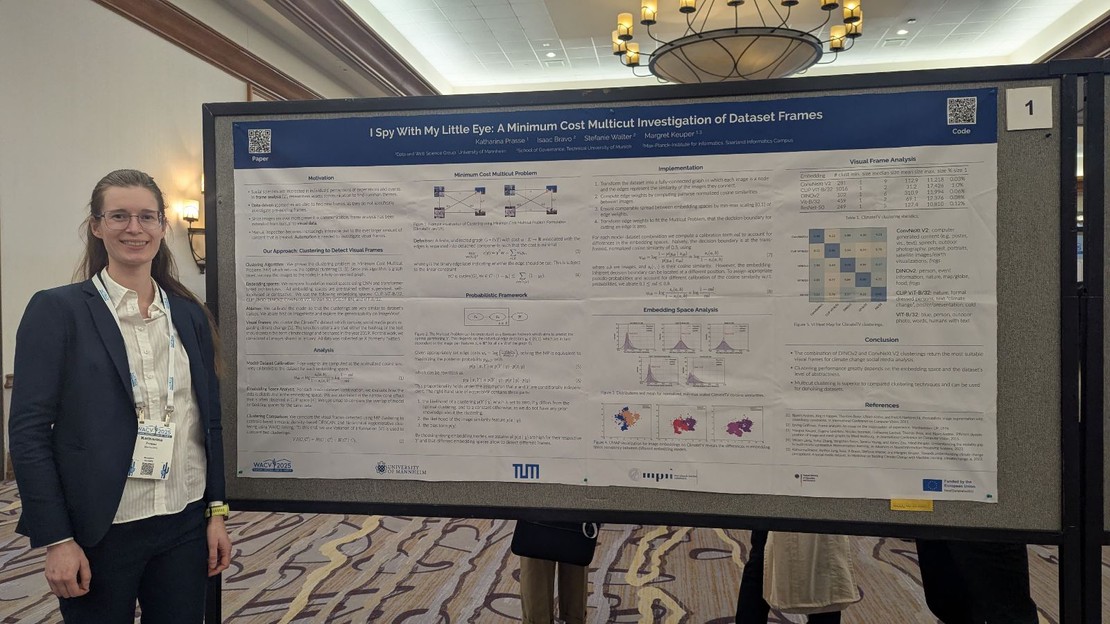
Climate Visions at WACV25
We presented our paper “I Spy With My Little Eye: A Minimum Cost Multicut Investigation of Dataset Frames” which was a joint work by Katharina Prasse, Isaac Bravo, Stefanie Walter, and Margret Keuper. The paper can be found here.
Read More
Our work was accepted to WACV25: Applications Track
We are looking forward to present our automatic visual frame detection method at the Winter Conference for Computer Vision Applications in Tucson, Arizona, USA.
In this work we phrase clustering as a minimum-cost multicut problem and argue for its use in visual frame detection. We show its merit on 2 toy dataset and on real-life X (formerly Twitter) images.
Read More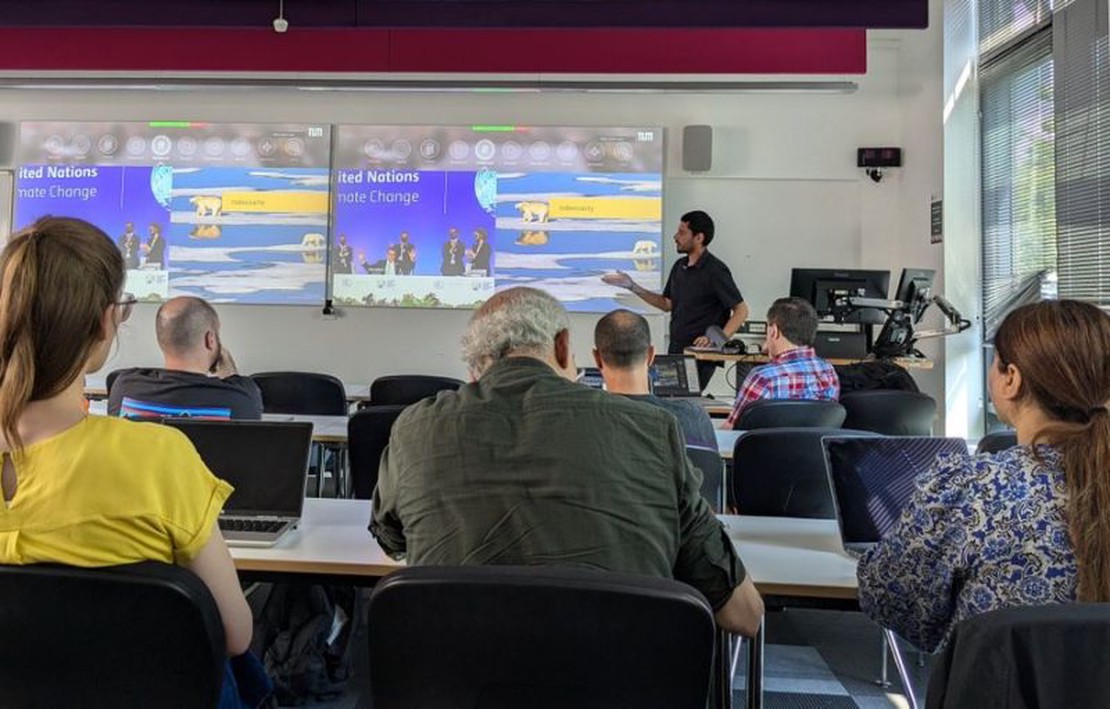
C3DS Seminar Explores Visual Framing of Climate Change Imagery on Twitter
The Centre for Climate Communication and Data Science (C3DS) hosted a seminar on June 26th, 2024, featuring Isaac Bravo from the Technical University of Munich, Germany. Bravo presented his research on the “Visual Framing of Climate Change Imagery on Twitter.”
The hybrid seminar was held both in person at the University of Exeter’s Streatham Campus and online via Zoom.
Bravo’s research delves into how the framing of climate change imagery on social media platforms like Twitter influences people’s emotional engagement with the issue. His work also explores how this engagement varies across different regions of the world, where the impacts of climate change are experienced and expressed differently. Traditional research in this area has often focused on a limited selection of iconic climate change images, primarily using qualitative methods and data from Western countries. Bravo’s study takes a novel computational approach, combining framing theory with automated image and text analysis to analyze millions of images, tweets, and user responses shared on Twitter between 2019 and 2022. Data collection for the study involved using the search term “climate change/#climatechange” in English, Spanish, German, French, Arabic, Chinese, and Russian. The research team utilized the Contrastive Language-Image Pre-Training model to analyze and classify images, and employed various text analysis techniques to examine people’s emotions in tweet texts and comments.
Read More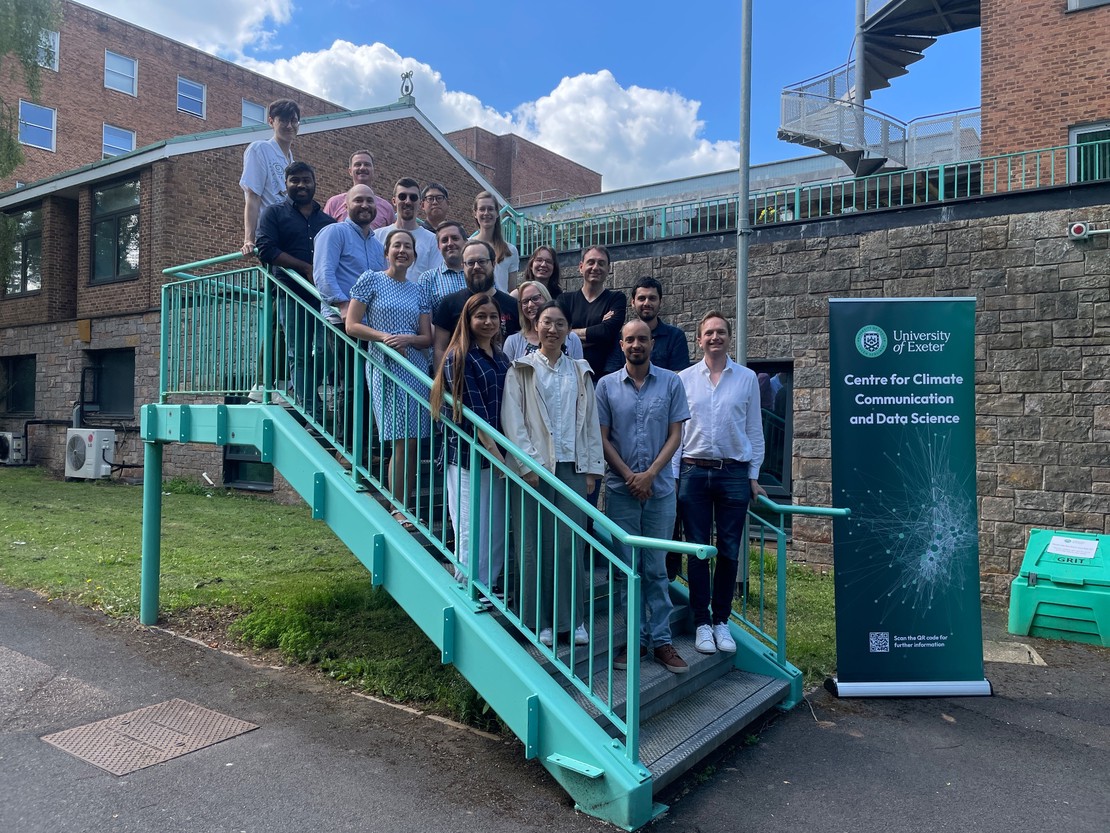
CCVision Network Meeting at C3DS in Exeter
It was great to discuss climate change from various perspective with a network of like-minded scholars. Thank you to the organizers (Claire Banwell) and all attendees for the inspiring discussions! We are looking forward to next year. Photo credits to Veronica White.
Katharina Prasse gave a talk on the opportunities and pitfalls of working with foundation models.
Presentation at the EUFeels Workshop: Emotions in European Climate Politics
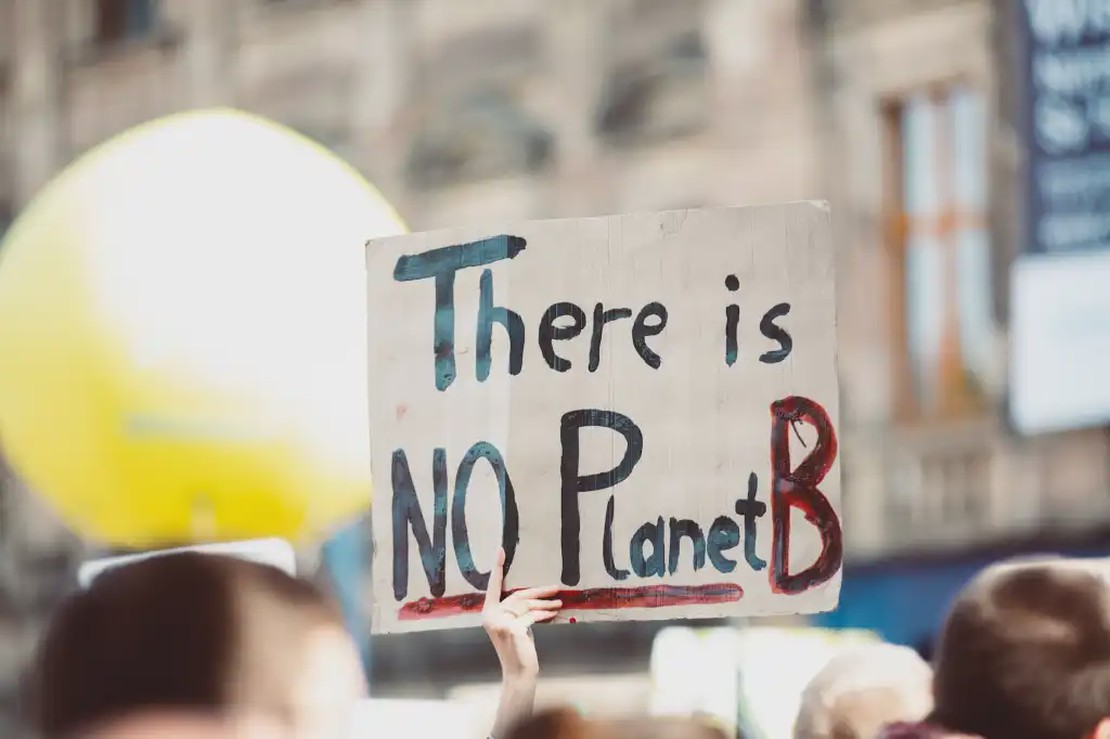
Isaac Bravo (M.Sc) attended a workshop on Emotions in European climate politics. The workshop was hosted by the Amsterdam Centre for European Studies, which had a focus on emotions and affective dynamics in European climate change politics, including the role of the EU in these debates, and Europe in a global context.
Read More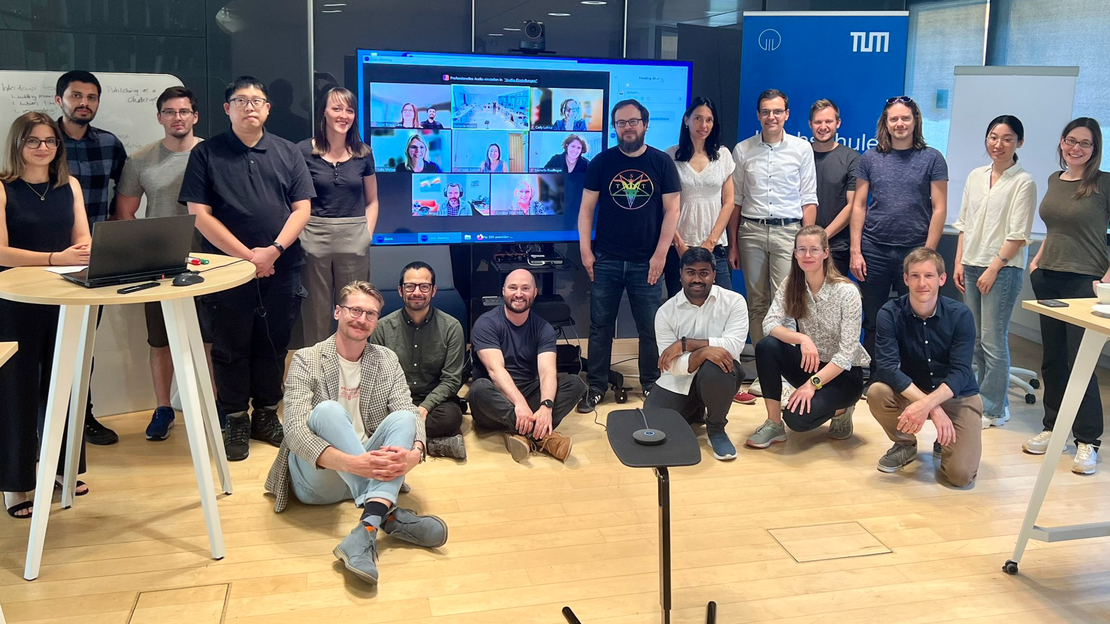
Climate Change Visuals Workshop at the Technical University of Munich
Climate Vision Project, on behalf of Stefanie Walter, PhD (Technical University of Munich), hosted this workshop along with Prof. Dr Mike S. Schäfer (University of Zurich) on 12 June 2023. The workshop discussed the state of the research field that analyzes climate change visuals, how computational approaches can help in the study of climate change imagery, the respective methods of data acquisition and analyses, and the specifics of collaboration between the social and computer sciences.
Read More